Why Banning Things Makes People Want Them More

Why Banning Things Makes People Want Them More

Action Bias: Why Doing Nothing Is Often the Best Move

Illusory Superiority: Why You Think You're Above Average

Status Quo Bias: Why Your Brain Fears Change

The Waiter Rule: Psychology of How You Treat Servers

Cheerleader Effect: Why You Look Better in Group Photos
TL;DR: The von Restorff effect explains why distinctive items are remembered better than similar ones, with applications spanning marketing, education, and UX design for enhanced memory and engagement.
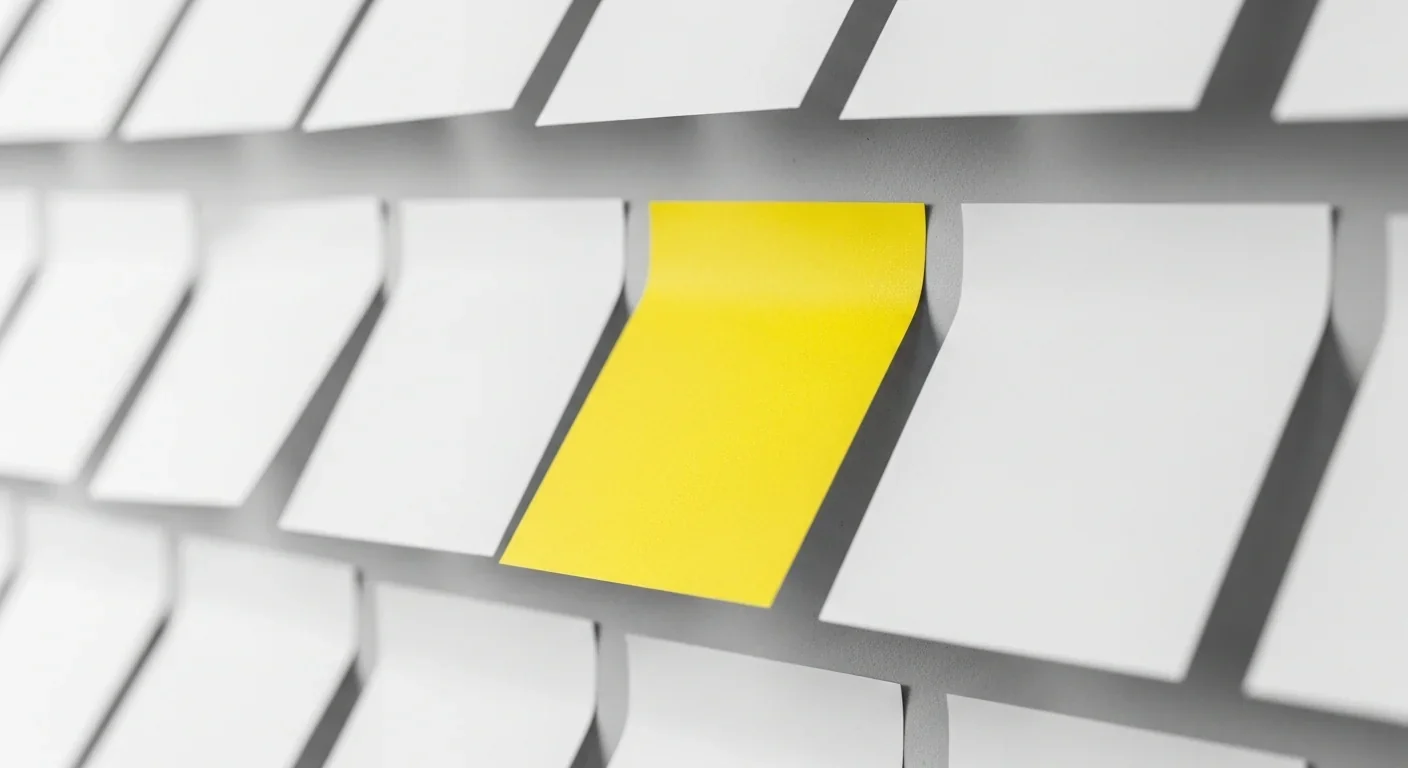
Remember the last presentation you attended. You probably forgot most slides, but that one with the bright yellow background? It's still crystal clear in your mind. That's not coincidence. Your brain is wired to remember what stands out, and scientists have been studying this phenomenon since 1933 when German psychiatrist Hedwig von Restorff discovered something remarkable about human memory.
When your brain encounters a stream of similar information, it essentially goes on autopilot. But throw in something different, something that breaks the pattern, and suddenly your neural circuits light up like a Christmas tree. This is the von Restorff effect in action, also known as the isolation effect, and it's one of the most powerful forces shaping what you remember and what you forget.
Modern neuroscience has revealed exactly what happens in your brain when you encounter something distinctive. Brain imaging shows increased activity in the hippocampus, your brain's memory center, when processing items that stand out from the crowd. But it goes deeper than that. Your prefrontal cortex, responsible for attention and decision-making, also kicks into high gear, essentially telling the rest of your brain: "Hey, this is important. Store this one carefully."
The effect works because of a fundamental limitation: your cognitive resources are finite. In any moment, you're bombarded with thousands of pieces of information, from the color of the walls to the sound of traffic outside. Your brain can't possibly remember everything, so it has to be selective. And what does it select? The unusual, the distinctive, the things that violate expectations.

Recent experiments published in 2024 have shown just how robust this effect really is. When researchers presented participants with lists of words where one item was printed in a different color or font, that distinctive item was recalled up to 70% more often than the uniform items around it. But here's where it gets interesting: the effect isn't just about visual distinctiveness.
The isolation can be semantic (a word about vegetables in a list of furniture), emotional (a sad word among neutral ones), or even temporal (an item presented at an unusual speed). Your brain treats all these forms of distinctiveness as signals that something deserves special attention. This isn't just about memory either. Studies using event-related potentials show that distinctive items trigger a stronger P300 brain wave, indicating enhanced processing that happens within 300 milliseconds of seeing the item. You're not consciously deciding to remember it better. Your brain makes that decision for you, almost instantly.
"When multiple homogeneous stimuli are presented, the stimulus that is conspicuously distinct or isolated will be remembered more effectively."
- Hedwig von Restorff, 1933
What makes this even more fascinating is that the effect persists across all ages, though its strength varies. Children show the strongest response to visual distinctiveness, while adults respond more to semantic uniqueness. Older adults still experience the effect, but they need stronger contrasts to trigger it. This suggests the isolation effect isn't learned but rather a fundamental aspect of how human memory evolved.
Walk into any grocery store and you'll see the von Restorff effect weaponized for profit. That bright red "SALE" tag on a sea of white price labels? That's not random. Marketing professionals have long understood that making something stand out dramatically increases the chances customers will notice and remember it.
Consider Coca-Cola's iconic red cans. In a refrigerator full of beverages, that distinctive red immediately draws your eye. Or think about Apple's minimalist white packaging in a world of colorful, busy designs. These companies aren't just designing for aesthetics. They're designing for memory. The isolation effect explains why certain advertisements stick with you for years while others vanish instantly. Research on consumer behavior shows that products displayed with distinctive packaging are not only noticed more but are also perceived as higher quality, even when the actual product is identical.

But there's a catch that many marketers miss. The effect has a saturation point. When everything tries to stand out, nothing does. If every product on the shelf has a bright red "SALE" sticker, the distinctive element loses its power. Smart designers know that restraint is key. One distinctive element works beautifully. Five distinctive elements competing for attention? That's just noise.
The von Restorff effect has a saturation point. When everything tries to stand out, nothing does. Strategic restraint is more powerful than overwhelming distinctiveness.
In the digital world, the von Restorff effect has become the secret sauce of user experience design. Every time you instantly spot the "Buy Now" button on Amazon or notice the notification badge on your phone, you're experiencing this effect in action. UX designers deliberately leverage distinctiveness to guide your attention exactly where they want it.
The most successful websites don't just randomly make things stand out. They create what designers call a "visual hierarchy" where the isolation effect is carefully orchestrated. The call-to-action button might be the only green element on a page full of blues and grays. The important warning message uses a different font weight. The limited-time offer has a subtle animation while everything else is static.
A/B testing has proven that properly implemented isolation can increase conversion rates by up to 30%. But again, moderation matters. When designers try to make too many elements distinctive, users become overwhelmed and engagement actually drops. The human brain can really only process one "special" thing at a time in any given context.
Social media platforms have mastered this principle. The red notification dot on Facebook, the orange upvote on Reddit, the heart animation on Instagram. These aren't random design choices. They're carefully crafted to hijack your brain's natural tendency to notice and remember what's different. The psychology behind these interfaces is sophisticated and purposeful.
Students and educators are catching on to what memory researchers have known for decades. Making information distinctive doesn't just help you notice it. It fundamentally changes how your brain encodes and retrieves that information. The key is strategic isolation, not random highlighting.

Here's what actually works: Instead of highlighting entire paragraphs in your textbook (which removes the distinctiveness), highlight only the single most important sentence on each page. Use different colors, but systematically. Red for definitions, blue for examples, green for formulas. Your brain will automatically categorize and prioritize based on these distinctive markers. The serial position effect combines powerfully with the isolation effect. Information at the beginning and end of study sessions is already more memorable. Add distinctiveness to items in the middle, and you've essentially hacked your memory.
Memory athletes and mnemonics experts take this even further. They don't just make information visually distinctive. They make it semantically bizarre. The more unusual and unexpected the association, the stronger the memory trace. This is why memory palace techniques work so well. You're not just remembering information. You're remembering distinctive, unusual information placed in familiar contexts.
"The isolated item benefits from enhanced elaborative rehearsal, creating a stronger retrieval cue that persists even after weeks or months."
- Cognitive Psychology Research, 2024
Teachers who understand this principle structure lessons differently. Instead of presenting similar examples repeatedly, they introduce one dramatically different example that illustrates the same concept. That distinctive example becomes the anchor that helps students remember the entire principle. Studies show students remember unusual examples up to three times better than conventional ones.
Recent advances in brain imaging have revealed something surprising about the von Restorff effect. It's not just about attention or encoding. The effect actually changes how memories are consolidated during sleep. Distinctive items receive preferential treatment during memory replay, the process where your brain rehearses and strengthens memories while you rest.
The predictive coding model offers a new framework for understanding why. Your brain constantly generates predictions about what it will encounter next. When something violates these predictions, when it's distinctive or unexpected, your brain treats this as a prediction error that needs special processing. This error signal triggers enhanced encoding that makes the memory more durable and easier to retrieve.
Neuroscientists have identified specific neural pathways involved in processing distinctiveness. The pathway from the hippocampus to the medial prefrontal cortex shows increased connectivity when encoding distinctive items. This enhanced connectivity persists even weeks after the initial encoding, suggesting that distinctive memories are wired differently in your brain from the start.
The oddball paradigm used in neuroscience research has become the gold standard for studying this effect. By presenting rare stimuli among frequent ones while monitoring brain activity, researchers can watch the isolation effect unfold in real-time. The P300 wave, the N400 response for semantic violations, the enhanced gamma oscillations. Each tells part of the story of how your brain privileges the distinctive.
Despite its power, the von Restorff effect isn't magic. Many people misunderstand how it works and overestimate what it can do. The biggest misconception? That making something stand out guarantees it will be remembered. In reality, distinctiveness only helps if there's sufficient processing. Flash a distinctive item for a millisecond, and the effect disappears.
Context matters enormously. Something distinctive in one environment might be completely ordinary in another. A businessman in a suit stands out at the beach but disappears in a boardroom. The isolation effect is always relative to the surrounding context. This relativity explains why the effect can sometimes backfire. Make something too distinctive, too weird, and people might remember that it was weird but forget the actual content. The sweet spot is distinctiveness that enhances rather than overshadows the message.
Another limitation: the effect weakens with repetition. The first time you see a fluorescent yellow highlighter mark, it grabs your attention. By the hundredth time, your brain has adapted, and the distinctiveness loses its power. This habituation is why marketers constantly need to refresh their distinctive elements to maintain effectiveness.
Individual differences matter: People with ADHD may need stronger distinctiveness to trigger the effect. Cultural background influences what counts as distinctive. What stands out to someone from New York might be completely normal to someone from Tokyo.
Research on memory and perception shows that individual differences also play a role. People with ADHD may need stronger distinctiveness to trigger the effect. Those with autism might respond differently to semantic versus perceptual distinctiveness. Cultural background influences what counts as distinctive. What stands out to someone from New York might be completely normal to someone from Tokyo.
Not all applications of the von Restorff effect are benign. Illusory correlations can form when distinctive events are incorrectly associated simply because they both stand out. If a person from a minority group does something negative and both the group membership and the behavior are distinctive, people are more likely to form false stereotypes linking the two.
The availability heuristic interacts dangerously with the isolation effect. We judge the probability of events based on how easily we can recall examples. Distinctive, memorable events seem more common than they actually are. This is why people overestimate the likelihood of plane crashes (distinctive and memorable) while underestimating the risk of car accidents (common and forgettable).
In the attention economy, the von Restorff effect can be weaponized to manipulate rather than inform. Clickbait headlines use distinctiveness to grab attention without delivering value. Fake news often spreads faster than truth because false information tends to be more distinctive and surprising. Understanding this effect means recognizing when it's being used against your best interests.
So how do you harness the von Restorff effect ethically and effectively? Start with intention. Whether you're designing a presentation, studying for an exam, or creating marketing materials, ask yourself: what's the one thing people absolutely must remember? Make that one thing distinctive, and resist the temptation to emphasize everything.
In presentations, use the 10% rule. No more than 10% of your slides should be distinctive. That might mean one slide with a bold background color, one with an unexpected image, or one with a radically different layout. These become your memory anchors that help people recall the entire presentation.
For learning, create distinctive encoding moments. Don't just read information passively. Generate unusual examples, create bizarre mental images, or study important concepts in unusual locations. The distinctiveness doesn't have to be visual. It can be contextual, emotional, or semantic. The key is intentional violation of expectations.
In professional communication, use distinctiveness strategically. The important deadline in your email might be the only bold text. The key recommendation in your report might be the only one with a border. The critical safety warning might be the only red text on the page. But remember: if you make everything distinctive, nothing is.
Looking ahead, our understanding of the von Restorff effect is opening new possibilities for memory enhancement. Researchers are exploring how to optimize distinctiveness for different types of information and different individuals. Personalized learning algorithms might soon adjust distinctiveness based on your individual response patterns.
Virtual and augmented reality environments offer unprecedented control over distinctiveness. Imagine studying history where important events literally pop out of the timeline, or learning anatomy where crucial structures glow while you explore a 3D model. The isolation effect in immersive environments could revolutionize education.
Brain-computer interfaces might one day allow us to directly enhance the encoding of distinctive information, artificially triggering the neural signatures associated with the von Restorff effect.
Brain-computer interfaces might one day allow us to directly enhance the encoding of distinctive information, artificially triggering the neural signatures associated with the von Restorff effect. While this sounds like science fiction, the neurological basis is already being mapped. We know which brain waves to enhance and which neural pathways to stimulate.
Understanding the von Restorff effect isn't just academic curiosity. It's practical knowledge about how your mind works. Every time you successfully remember something important, every time an advertisement catches your eye, every time you notice what matters in a sea of information, you're experiencing this fundamental principle of human cognition. The things that stand out don't just get noticed. They become part of who you are, shaping your memories, your decisions, and ultimately, your life. In a world overflowing with information, understanding how to make things memorable, and recognizing when others are using these techniques on you, isn't just useful. It's essential.
The next time you need to remember something important, don't just repeat it. Make it different. Make it stand out. Make it memorable. Your brain is already wired for it. You just need to work with your neural programming, not against it. And in our age of infinite content and finite attention, mastering the art and science of standing out might be the most valuable skill you can develop.

Project Orion was a real 1960s program to reach other stars by detonating 800 nuclear bombs behind a spacecraft. The physics worked and the engineering was feasible, but the 1963 nuclear test ban treaty killed it. It remains the most credible interstellar spacecraft ever designed.
The locus coeruleus, a tiny brainstem structure, degenerates decades before Alzheimer's symptoms appear. Its loss cripples the brain's inflammation control, waste clearance, and sleep regulation. New imaging tools and noradrenergic therapies offer hope for early detection and prevention.

Research shows the sharing economy often increases total resource consumption through the Jevons paradox and rebound effects. Ride-sharing adds billions of vehicle miles, co-working spaces use more energy per worker, and diffused responsibility erodes conservation behavior. Breaking the paradox requires congestion pricing, accountability design, and matching sharing models to appropriate resource types.
Psychological reactance theory explains why banning or restricting things makes people want them more. From Prohibition to the Streisand effect to scarcity marketing, research shows that threatening people's freedom reliably backfires, and autonomy-supportive communication is far more effective.

A carnivorous pitcher plant in Borneo evolved to house bats instead of trapping insects, gaining up to 95% of its nitrogen from bat guano. The plant even built an ultrasonic reflector to help bats find it, revealing that carnivory in plants is a flexible spectrum.

The quantified self movement began as a hacker-ethos pursuit of personal insight, but corporate wearables now funnel biometric data to employers, insurers, and data brokers. With 81% of Americans wrongly believing health apps are HIPAA-protected, a regulatory void enables health data to be sold for pennies while generating anxiety instead of empowerment.

CXL memory pooling lets servers dynamically share DRAM over a cache-coherent interconnect, eliminating the 40% stranded memory waste in data centers. With commercial hardware now shipping and Azure deploying CXL cloud instances, this technology promises to cut memory costs by 50% while enabling composable infrastructure.

Loading featured articles...