Why Banning Things Makes People Want Them More

Why Banning Things Makes People Want Them More
Action Bias: Why Doing Nothing Is Often the Best Move

Illusory Superiority: Why You Think You're Above Average

Status Quo Bias: Why Your Brain Fears Change

The Waiter Rule: Psychology of How You Treat Servers

Why We're Bad at Predicting Happiness: Focusing Illusion
TL;DR: The cheerleader effect is a proven cognitive bias where people look more attractive in groups because the brain automatically averages faces, smoothing out individual flaws. Research shows the sweet spot is 3-5 people, it works for all genders, and it has real implications for dating apps and social media strategy.

Your brain is lying to you about how attractive people are. And the trick is surprisingly simple: just add more faces.
That friend who always looks stunning in group shots but somehow less striking in solo selfies? It's not the lighting, and it's not the angle. It's a cognitive bias hardwired into your visual system, one that researchers have mapped, measured, and turned into actionable advice for anyone curating a dating profile or Instagram feed. Welcome to the cheerleader effect, the phenomenon where everyone looks better when they're standing next to someone else.
The cheerleader effect got its name from an unlikely place. In a 2008 episode of How I Met Your Mother, the character Barney Stinson pointed at a group of women in a bar and declared them attractive as a pack, but unremarkable individually. He called it "the cheerleader effect" and also offered aliases like the "Bridesmaid Paradox" and the "Sorority Girl Syndrome." The audience laughed. Five years later, psychologists Drew Walker and Edward Vul at the University of California San Diego decided to test whether Barney was actually onto something.
He was. In a series of five experiments published in Psychological Science, Walker and Vul showed participants photographs of faces, sometimes in groups of four, nine, or sixteen, and sometimes alone. The result was consistent and statistically significant: people rated the exact same face as more attractive when it appeared alongside other faces than when it appeared in isolation. The effect held for both male and female subjects, across different group compositions, and even when the "group" was just a collage of unrelated photos arranged side by side.
The boost wasn't enormous. Walker estimated it was enough to shift someone from the 49th percentile of attractiveness to the 51st. As co-researcher Ed Vul noted with characteristic dry humor: "The effect is definitely small, but some of us need all the help we can get."
So what's actually happening when you glance at a group photo? The answer lies in a process neuroscientists call ensemble coding, and it reveals just how much heavy lifting your visual system does without asking permission.
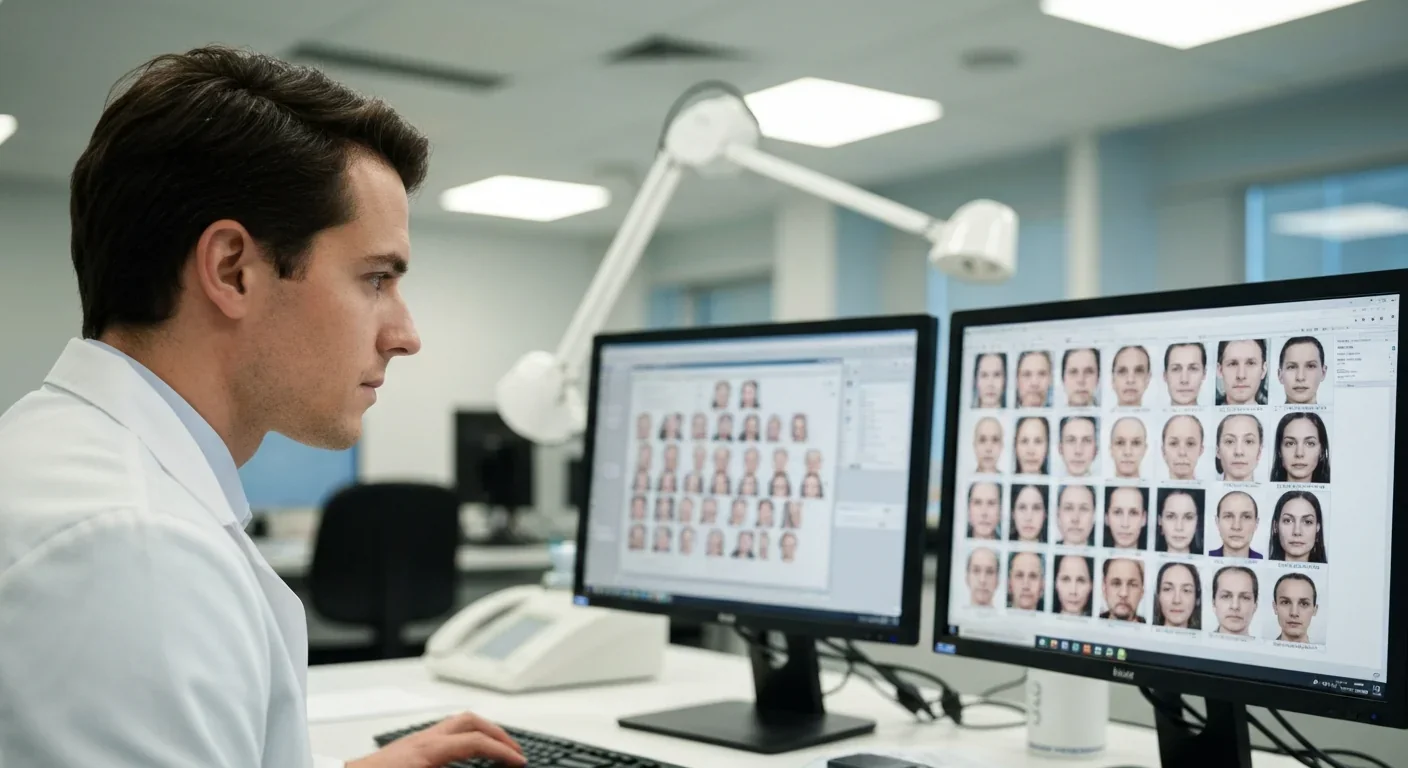
When you look at a crowd of faces, your brain doesn't painstakingly analyze each one feature by feature. That would take far too long and consume too many cognitive resources. Instead, it computes a quick statistical summary, a kind of mental average of all the faces in view. This shortcut happens fast, within about 50 milliseconds according to research on ensemble perception, which means your brain has already generated its average before you've consciously registered who's in the photo.
Here's where things get fascinating. Averaged faces happen to be attractive faces. This isn't a new finding. Back in 1990, psychologists Langlois and Roggman created computer-generated composites by digitally blending 2, 4, 8, 16, and 32 individual faces together. A panel of 300 judges consistently rated the 32-face composite as the most attractive of all, more attractive than any of the real faces that went into it.
Why does averaging make faces look better? Because it smooths things out. That slightly crooked nose, the asymmetric jawline, the one eye that sits a fraction higher than the other, all those individual quirks get ironed flat in the composite. What's left is a face that's symmetrical, prototypical, and oddly familiar. Our brains are wired to find that combination appealing.
"Perhaps it's like Tolstoy's families. Beautiful people are all alike, but every unattractive person is unattractive in their own way."
- Drew Walker, UC San Diego
The cheerleader effect piggybacks on this exact mechanism. When your brain creates that rapid group average, it then uses the slightly-more-attractive composite as a reference point for judging each individual face in the scene. Everyone in the group inherits a perceptual "halo" from the average, making them look just a touch better than they would standing alone.
Not quite. Researchers have uncovered some important asymmetries about who benefits most and under what conditions.
Gender doesn't seem to matter much. Walker and Vul's original experiments showed the effect operates for both men and women at roughly comparable magnitudes. A 2020 follow-up study even extended the finding beyond faces, demonstrating that bodily attractiveness gets the same group boost.

Group size, on the other hand, matters a great deal. The sweet spot appears to be three to five people. Too few faces and the brain doesn't generate a strong enough average. Too many, and individual faces become too small and indistinct for the averaging process to provide a benefit. Laboratory research on ensemble coding capacity confirms that the visual system starts experiencing what scientists call "redundancy loss" as group size grows, with processing becoming measurably slower and less precise beyond about four faces.
The cheerleader effect peaks with groups of 3 to 5 people. Smaller groups don't generate a strong enough average, while larger groups make individual faces too small to benefit from the brain's smoothing process.
The attractiveness of your groupmates matters too. The effect is strongest when everyone in the group has roughly comparable attractiveness levels. If you stand next to someone dramatically more attractive, the contrast can actually hurt you by creating an unfavorable direct comparison rather than a beneficial average.
And here's one factor that doesn't matter at all: familiarity. A 2024 study published in the Quarterly Journal of Experimental Psychology found that the cheerleader effect occurs whether you know the faces or not. It's a low-level perceptual phenomenon, not something shaped by your relationship with the people in the photo.
If you've ever wondered why dating coaches advise including at least one group photo in your profile, the cheerleader effect is the scientific justification. Group photos give you a small but measurable attractiveness boost simply by activating your viewer's ensemble coding machinery.
But there's a catch, and it's a big one. A 2025 study covered in Psychology Today confirmed what most dating app users already intuit: the profile photo dominates the swipe decision. In an experiment with 445 participants in Germany, a more attractive picture dramatically boosted someone's odds of being chosen, more than job title, biography, height, or IQ combined.
Group photos can activate the cheerleader effect, but they also carry real risks on dating platforms. The biggest problem is confusion. If a potential match can't quickly identify which person you are, they'll swipe left rather than play "Where's Waldo?" Dating experts generally recommend one strategic group photo showing you with three to four friends, positioned as a secondary image behind a clear, well-lit solo shot.

The lesson extends well beyond dating. On Instagram, LinkedIn, and any platform where your photo creates the first impression, the same attractiveness biases are at work. Curated group photos function as a subtle form of social proof, signaling that you're well-connected and socially fluent while simultaneously benefiting from ensemble averaging. A survey across 60 countries found that 83% of consumers trust recommendations from friends over any other form of advertising, and group imagery taps into the same psychological infrastructure.
The cheerleader effect sits inside a much larger constellation of attractiveness biases that shape how we navigate daily life. The most well-known is the halo effect, first described by psychologist Edward Thorndike in 1920, which causes us to automatically assume that attractive people are also smarter, kinder, and more competent.
The real-world consequences are significant. Research confirms that people subconsciously attribute positive characteristics like honesty and intelligence to physically attractive individuals, even based on minimal evidence. A 2025 study of 43,000 MBA graduates found that attractive graduates earned an average of $2,508 more per year and were 52.4% more likely to hold prestigious positions 15 years after graduation. In a separate 2023 study with 2,748 participants, simply applying a beauty filter to a face raised ratings of intelligence, trustworthiness, and sociability on standardized scales.
Attractive MBA graduates earned $2,508 more per year and were 52.4% more likely to hold prestigious positions 15 years after graduation, according to a 2025 study of 43,000 graduates. The cheerleader effect may feed directly into this beauty premium.
The cheerleader effect is distinct from the halo effect but likely interacts with it. When a group photo makes you look more attractive through ensemble averaging, the halo effect may then amplify that boost, leading viewers to perceive you as more competent, more friendly, and more worth swiping right on.
This isn't a Western cultural artifact or a modern social media trick. Research involving over 1,500 faces from 10 different populations worldwide has confirmed that averageness is a universal driver of attractiveness. Lower distinctiveness, meaning higher averageness, strongly predicted higher ratings for both sexes, independent of symmetry or cultural norms.
The preference might even be hardwired by evolution. Evolutionary theorists propose that average faces signal genetic health and developmental stability, since extreme deviations from the population norm could indicate mutations or environmental stress. This idea, called koinophilia, suggests our attraction to averageness is encoded deep in our biology.
"Human observers are able to extract the mean emotion or other type of information from a set of faces, even within exposures as brief as 50 milliseconds."
- Frontiers in Psychology, ensemble coding research
The evidence goes deeper still. Infants as young as six months show a preference for averaged composite faces over individual ones. Even rhesus macaque infants prefer averaged faces of their own species. The brain's face-averaging system isn't just universal across human cultures, it appears to be universal across primates.
Modern research keeps revealing how resilient this system is. A 2024 study published in the Journal of Vision found that people can still accurately extract the group average even when faces are partially hidden by surgical masks or sunglasses. The cheerleader effect, it seems, keeps working even when half the face is covered.
Understanding the cheerleader effect won't make it stop happening. Your brain will keep averaging faces whether you want it to or not. But knowing the science gives you genuine leverage over how you present yourself and how you evaluate others.
For dating apps, include one group photo with three to four friends of similar attractiveness. Make sure you're clearly identifiable. Lead with a strong solo shot, and let the group photo work its quiet magic from the second or third slot in your lineup.
For social media, group photos consistently attract more likes and engagement than solo shots. Post them strategically, but don't make every image a group shot or your personal brand disappears into the crowd.
For the skeptics: yes, attractiveness is more flexible than most people believe. Smiles, eye contact, grooming, lighting, and authenticity all shift perception. The cheerleader effect is just one tool among many.
And for everyone scrolling through photos tonight, remember this: the next time you see a group and think "they're all so good-looking," your visual cortex just pulled off its oldest trick. Now you know how it works. The question is whether you'll use that knowledge, or simply keep falling for it.

Project Orion was a real 1960s program to reach other stars by detonating 800 nuclear bombs behind a spacecraft. The physics worked and the engineering was feasible, but the 1963 nuclear test ban treaty killed it. It remains the most credible interstellar spacecraft ever designed.

The locus coeruleus, a tiny brainstem structure, degenerates decades before Alzheimer's symptoms appear. Its loss cripples the brain's inflammation control, waste clearance, and sleep regulation. New imaging tools and noradrenergic therapies offer hope for early detection and prevention.

Research shows the sharing economy often increases total resource consumption through the Jevons paradox and rebound effects. Ride-sharing adds billions of vehicle miles, co-working spaces use more energy per worker, and diffused responsibility erodes conservation behavior. Breaking the paradox requires congestion pricing, accountability design, and matching sharing models to appropriate resource types.
Psychological reactance theory explains why banning or restricting things makes people want them more. From Prohibition to the Streisand effect to scarcity marketing, research shows that threatening people's freedom reliably backfires, and autonomy-supportive communication is far more effective.

A carnivorous pitcher plant in Borneo evolved to house bats instead of trapping insects, gaining up to 95% of its nitrogen from bat guano. The plant even built an ultrasonic reflector to help bats find it, revealing that carnivory in plants is a flexible spectrum.

The quantified self movement began as a hacker-ethos pursuit of personal insight, but corporate wearables now funnel biometric data to employers, insurers, and data brokers. With 81% of Americans wrongly believing health apps are HIPAA-protected, a regulatory void enables health data to be sold for pennies while generating anxiety instead of empowerment.

CXL memory pooling lets servers dynamically share DRAM over a cache-coherent interconnect, eliminating the 40% stranded memory waste in data centers. With commercial hardware now shipping and Azure deploying CXL cloud instances, this technology promises to cut memory costs by 50% while enabling composable infrastructure.

Loading featured articles...